 By Owen Palmer
Updated November 2026
If you want the best drip coffee maker no plastic parts touch your coffee, the real question is which brewing surfaces and water paths are plastic-free, and which machine fits how many cups you make each morning. This list compares six models by the materials that contact hot water and coffee, the brew method, capacity, and how easy each one is to clean. Plastic-free claims are taken from manufacturer listings and owner feedback patterns.
Our top picks at a glance
- 1
 TOP CHOICEBest overallSimplyGoodCoffee THE BREWER – Plastic-Free (2nd-Gen). Coffee Maker/CofView on Amazon
- 2
 TOP CHOICEBest for built-in controlNo Plastic in Contact with Beverages Programmable Drip Coffee Maker with Built-in ScaleView on Amazon
- 3
 TOP CHOICEBest for big batchesElectric Coffee Percolator, 10-Cup Glass Percolator Coffee Pot, 100% Plastic-Free BrewingView on Amazon
- 4
 Best for heat retentionNon-Toxic Stainless Steel French Press, No Plastic or Heavy Metals, 34 ozView on Amazon
- 5
 Best for classic looksElectric Coffee Percolator Stainless Steel 1.8L 12 CupView on Amazon
- 6
 Best for pour-over styleAutomatic Drip Coffee Maker for Coffee Enthusiasts -Pour Over Coffee BView on Amazon
Our Top Picks
Quick Comparison
| Product | Best for | Key feature |
|---|---|---|
| SimplyGoodCoffee THE BREWER | Overall plastic-free drip | Gold cup, steel parts |
| Programmable drip with built-in scale | Controlled brew strength | Adjustable strength setting |
| 10-cup glass percolator | Big batches | Borosilicate glass carafe |
| Stainless French press style brewer | Heat retention | Double-wall insulation |
| 12-cup stainless electric percolator | Classic look and volume | Tempered glass knob |
| Automatic pour-over simulation brewer | Pour-over flavor at home | Hand-drip simulation mode |
SimplyGoodCoffee THE BREWER – Plastic-Free (2nd-Gen). Coffee Maker/Coffee Machine. 8 Cup Automatic Drip Pour Over Coffee Brewer
SimplyGoodCoffee THE BREWER – Plastic-Free (2nd-Gen). Coffee Maker/Coffee Machine. 8 Cup Automatic Drip Pour Over Coffee Brewer Free of Plastic, Gold Cup Standard. Black/Stainless Steel
Best for: Overall plastic-free drip brewing
This suits households that want a straightforward 8-cup drip machine with the water path kept free of plastic.
Pros We also found 6 Best No Sugar BBQ Rubs for Flavor Without the Sweetness (2026) useful on this point.
- Marketed as free of plastic in the brew path
- Gold cup standard, no plastic basket
Cons
- Plastic-free claims should be checked against the full parts list
No Plastic in Contact with Beverages Programmable Drip Coffee Maker with Built-in Scale
No Plastic in Contact with beverages, Built‑in Scale, Adjustable Strength, Single Serve or Full Carafe, 24 hrs Programmable Drip Coffee Maker Auto Pour Over Coffee Machine with Paper Filters
Best for: Controlled brew strength
Good for people who want to dial in strength and brew single cups or full carafes without switching machines.
Pros
- Adjustable strength and single-serve or full-carafe options
- Programmable timer for 24-hour scheduling
Cons
- Requires paper filters on every brew
Electric Coffee Percolator, 10-Cup Glass Percolator Coffee Pot, 100% Plastic-Free Brewing
Electric Coffee Percolator, 10-Cup Glass Percolator Coffee Pot, 100% Plastic-Free Brewing, Borosilicate Glass Coffee Maker with Reusable 304 Stainless Steel Filter, Auto/Manual Knob & Keep Warm, 700W
Best for: Big batches
Fits larger households or anyone who brews for guests and wants the brew visible in a glass carafe.
Pros
- Borosilicate glass pot and reusable stainless filter
- Keep-warm function for extended serving
Cons
- Percolation brews stronger and less clean than drip
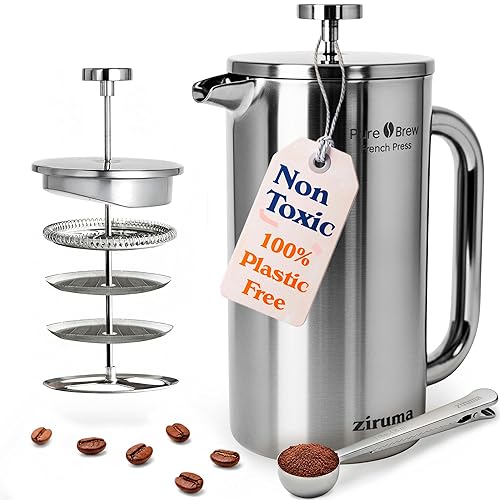
Non-Toxic Stainless Steel French Press, No Plastic or Heavy Metals, 34 oz
Surgical-grade steel. 4-layer filter. Double-wall insulated, stays hot for longer. Measure marks. Dishwasher safe. Portable. Non-Toxic Stainless Steel French Press, No Plastic or Heavy Metals, 34 oz
Best for: Heat retention
A good pick for those who want a steel brewer that keeps coffee hot without a hot plate, though it is a press rather than an automatic drip machine.
Pros
- Double-wall insulation and dishwasher-safe parts
- Four-layer filter and measure marks
Cons
- Manual brewing, not automatic
Electric Coffee Percolator Stainless Steel 1.8L 12 Cup
No Plastic or Aluminum, Tempered Glass Knob, Keep Warm Function, 1000W Fast Brewing, Cordless Serving Base, Classic Design Electric Coffee Percolator Stainless Steel 1.8L 12 Cup
Best for: Classic looks and volume
Works for households that want a traditional stovetop-style look with an electric base and a 12-cup capacity.
Pros
- No plastic or aluminum listed, tempered glass knob
- Cordless serving base and 1000W fast brewing
Cons
- Percolator style gives a bolder cup than standard drip
Automatic Drip Coffee Maker for Coffee Enthusiasts Pour Over Coffee Brewer with Programmable Timer
Automatic Drip Coffee Maker for Coffee Enthusiasts -Pour Over Coffee Brewer with Programmable Timer, Hand Drip Simulation, Adjustable Strength – No Aluminum No Plastic Contact with Beverage
Best for: Pour-over style at home
Suits drinkers who like the slow, even extraction of pour-over but want an automatic machine.
Pros
- Hand-drip simulation and adjustable strength
- Programmable timer and no aluminum in the contact path
Cons
- Pour-over simulation is less precise than manual pouring
Buying Guide
Check every contact surface
A machine can be marketed as plastic-free while still using plastic gaskets, lids or tubing. Read the full materials list and look for glass, stainless steel or ceramic on anything that touches water or grounds.
FAQ
Are glass and stainless steel coffee makers really free of plastic?
Many of these models use borosilicate glass or 304 stainless steel for the parts that touch hot water and coffee, which removes the most common plastic contact points. Some still have plastic handles, lids, gaskets, or outer housings, so check the product listing for the specific surfaces that contact the brew. Looking for a clear “no plastic in contact with beverages” statement is a good first step.
What should I check before buying a plastic-free drip coffee maker?
Look at the carafe, filter basket, water reservoir, tubing, and any seals or gaskets, since these are where plastic most often hides. Confirm whether the machine uses paper filters or a reusable metal filter, because the filter is a contact surface too. Reading the manufacturer’s material details and recent owner feedback can help you verify the claims.
Do I need paper filters with a plastic-free brewer?
It depends on the model. Some machines are designed to use paper filters, while others include a reusable stainless steel filter that avoids paper entirely. A reusable filter cuts ongoing costs and waste, but it may let a bit more fine sediment into your cup.
How do I clean a glass or stainless steel coffee maker?
Rinse the carafe and filter basket after each use and wash them with warm, soapy water to prevent oil buildup. Run a periodic cleaning cycle with a mild descaling solution to remove mineral deposits, following the manufacturer’s directions. Several models here are listed as dishwasher safe, but hand washing the glass parts can extend their life.
Is a percolator or a drip machine better if I want to avoid plastic?
Both can be plastic-free, but they brew differently. Drip makers filter water through grounds into a carafe for a cleaner cup, while percolators cycle boiling water through the grounds and tend to produce a bolder, heavier-bodied coffee. Choose based on the flavor you prefer and how much coffee you typically make.
How many cups should I choose for my household?
Think about your typical morning. Single-serve or small-capacity brewers suit one or two people, while 8 to 12 cup models fit families or anyone who hosts guests. Larger machines take more counter space, so measure your available area before deciding.
Conclusion
If you want the most complete plastic-free setup with a programmable drip brew, a glass or stainless steel drip maker with a reusable filter is the strongest fit, especially for daily use. If you prefer a bolder cup or a classic look, a stainless steel percolator or a French press-style option may suit you better, particularly for smaller households.
Whatever you choose, confirm the specific surfaces that touch your coffee and match the capacity to how many cups you brew each day. A little checking up front will give you a machine that keeps plastic out of your coffee and fits your routine.
Related reading
- Stainless Steel Drip Coffee Maker No Plastic: 6 Best Picks (2026)
- Plastic-Free Drip Coffee Maker Picks: 6 Best Glass and Steel Options (2026)
- Drip Coffee Maker Without Plastic: 6 Best Glass and Steel Picks (2026)
About Owen Palmer
Owen Palmer is part of our editorial team and reviews and edits our coffee machines guides, checking product details against manufacturer specifications and owner feedback.