Quick answer
Our overall pick for a compact espresso machine is the HBN Espresso Machine, which offers a stainless steel build and a familiar carafe design in a small footprint. The XIXUBX model is an ultra-lightweight option, while the Aercana and AMZCHEF machines suit those who want higher pump pressure and larger water tanks.
Finding a quality espresso machine that doesn’t dominate your counter can be a challenge. A best compact espresso machine should deliver the core functions of brewing and steaming while fitting into a small kitchen, dorm, or office. In this roundup, we compared manufacturer listings and specifications to identify machines that balance performance with a small footprint.
Our picks at a glance

Pros
- Stainless steel construction for durability.
- Includes a carafe with a water level gauge.
- Compact footprint and relatively light weight.
- Removable and washable drip tray for easy cleaning.
Cons
- The listing does not mention a cup warmer.
- Uses ground coffee only; no built-in grinder listed.
- Lower listed pressure (3.5 bar) compared to pump-driven machines.

Pros
- Smallest dimensions and lightest weight in the group.
- Features a safety lock and a BPA-free brewing cup.
- Simple one-knob mechanical control.
- Includes a water filter.
Cons
- The listing does not mention a cup warmer.
- Uses ground coffee only; no built-in grinder listed.
- Lower listed pressure (3.5 bar) compared to pump-driven machines.

Pros
- Compact width and depth.
- Includes a permanent filter (no paper filters needed).
- Comes with a milk frother.
- Removable drip tray for cleanup.
Cons
- The listing does not mention output pressure.
- Primarily plastic exterior construction.
- The listing does not mention a cup warmer.

Pros
- Higher listed pump pressure (20 bar).
- Includes a cup warmer and hot water dispenser.
- Removable 1-liter water tank.
- Narrow width saves counter space.
Cons
- Heavier wattage (1450W) may require a dedicated circuit; check your home's electrical capacity.
- The listing advises allowing the machine to cool between steaming and brewing cycles.
- Uses ground coffee only; no built-in grinder listed.
Pros
- Large, removable 50 oz water tank.
- Higher listed pump pressure (20 bar).
- Includes programmable shot buttons and PID temperature control.
- Steam wand rotates 360° for flexibility.
Cons
- Tallest and heaviest model in this comparison.
- Higher wattage (1350W); ensure your outlet can handle it.
- The listing does not mention a cup warmer.
How we chose
Our picks come from comparing manufacturer listings and specifications on Amazon as of October 2026. We did not test or use these machines hands-on. We focused on physical dimensions, listed features, and specifications to find machines that are genuinely compact and suitable for different needs.
Our primary criteria were overall dimensions (especially width and depth), weight, listed capacity, and the presence of features like a milk frother. We also noted the listed output pressure and operation mode to help you understand what each machine offers.
Best Compact Espresso Machines: our picks in detail
1. Best overall compact espresso machine: HBN Espresso Machine with Milk Frother
The HBN Espresso Machine is our overall pick for a compact espresso machine. It measures 12.91″D x 7.28″W x 13.58″H and weighs 4.1 pounds, making it a space-saving option. The listing states it has a 3.5 bar output pressure and an 800W heating system. It uses ground coffee with a #4 filter size and has a 240 ml capacity.
This semi-automatic machine is made of stainless steel and includes a carafe with a water level gauge, a milk frothing steam wand, and a removable drip tray. Operation is via a single control knob. The listing recommends a medium-coarse grind for optimal extraction.
Best for: Those who want a compact machine with a traditional carafe and stainless steel construction.
Pros
- Stainless steel construction for durability.
- Includes a carafe with a water level gauge.
- Compact footprint and relatively light weight.
- Removable and washable drip tray for easy cleaning.
Cons
- The listing does not mention a cup warmer.
- Uses ground coffee only; no built-in grinder listed.
- Lower listed pressure (3.5 bar) compared to pump-driven machines.
2. Best for ultra-compact spaces: XIXUBX Compact Espresso Machine
The XIXUBX Compact Espresso Machine is the smallest and lightest model we compared, measuring just 8.3″D x 6″W x 11.8″H and weighing 3.3 pounds. It has a listed 3.5 bar pressure and an 800W wattage. This semi-automatic machine brews into a BPA-free Tritan cup with scale marks and has a 240 ml capacity.
Features include a safety lock to prevent accidental detachment, a steam wand for milk frothing, and a simple one-knob control dial. It is designed for use with ground coffee and a #4 filter. Its small size makes it highly portable for dorms, RVs, or offices.
Best for: Anyone needing the smallest possible footprint, such as for dorm rooms, RVs, or tiny kitchens.
Pros
- Smallest dimensions and lightest weight in the group.
- Features a safety lock and a BPA-free brewing cup.
- Simple one-knob mechanical control.
- Includes a water filter.
Cons
- The listing does not mention a cup warmer.
- Uses ground coffee only; no built-in grinder listed.
- Lower listed pressure (3.5 bar) compared to pump-driven machines.
3. Best for a simple, low-pressure brewer: IMUSA 4 Cup Espresso Maker
The IMUSA 4 Cup Espresso Maker is a compact, semi-automatic machine with an 800W heating system. It measures 7.48″D x 9.05″W x 11.02″H and weighs 4.8 pounds. The listing states it has a 4-cup capacity and includes a milk frother.
This model features a permanent filter, eliminating the need for paper filters. It has a black plastic exterior with a heat-resistant design and includes a removable drip tray. The listing notes it is made with aluminum and other elements.
Best for: Those looking for a straightforward, compact machine with a permanent filter for making Cuban-style coffee.
Pros
- Compact width and depth.
- Includes a permanent filter (no paper filters needed).
- Comes with a milk frother.
- Removable drip tray for cleanup.
Cons
- The listing does not mention output pressure.
- Primarily plastic exterior construction.
- The listing does not mention a cup warmer.
4. Best for higher pressure in a small footprint: Aercana 20 Bar Espresso Machine
The Aercana Espresso Machine offers a higher listed pump pressure of 20 bar in a compact design measuring 12.2″D x 5.32″W x 11.5″H. It has a 1450W heating system and a 1-liter removable water tank. This semi-automatic machine includes a visible pressure gauge and a steam wand for milk frothing.
Features listed include a cup warmer, hot water dispenser, and auto shut-off. It is designed for use with ground coffee. The machine has a sleek stainless steel finish and is noted for its rapid heating system.
Best for: Coffee drinkers who want a machine with higher pump pressure and a larger water tank without a wide counter footprint.
Pros
- Higher listed pump pressure (20 bar).
- Includes a cup warmer and hot water dispenser.
- Removable 1-liter water tank.
- Narrow width saves counter space.
Cons
- Heavier wattage (1450W) may require a dedicated circuit; check your home’s electrical capacity.
- The listing advises allowing the machine to cool between steaming and brewing cycles.
- Uses ground coffee only; no built-in grinder listed.
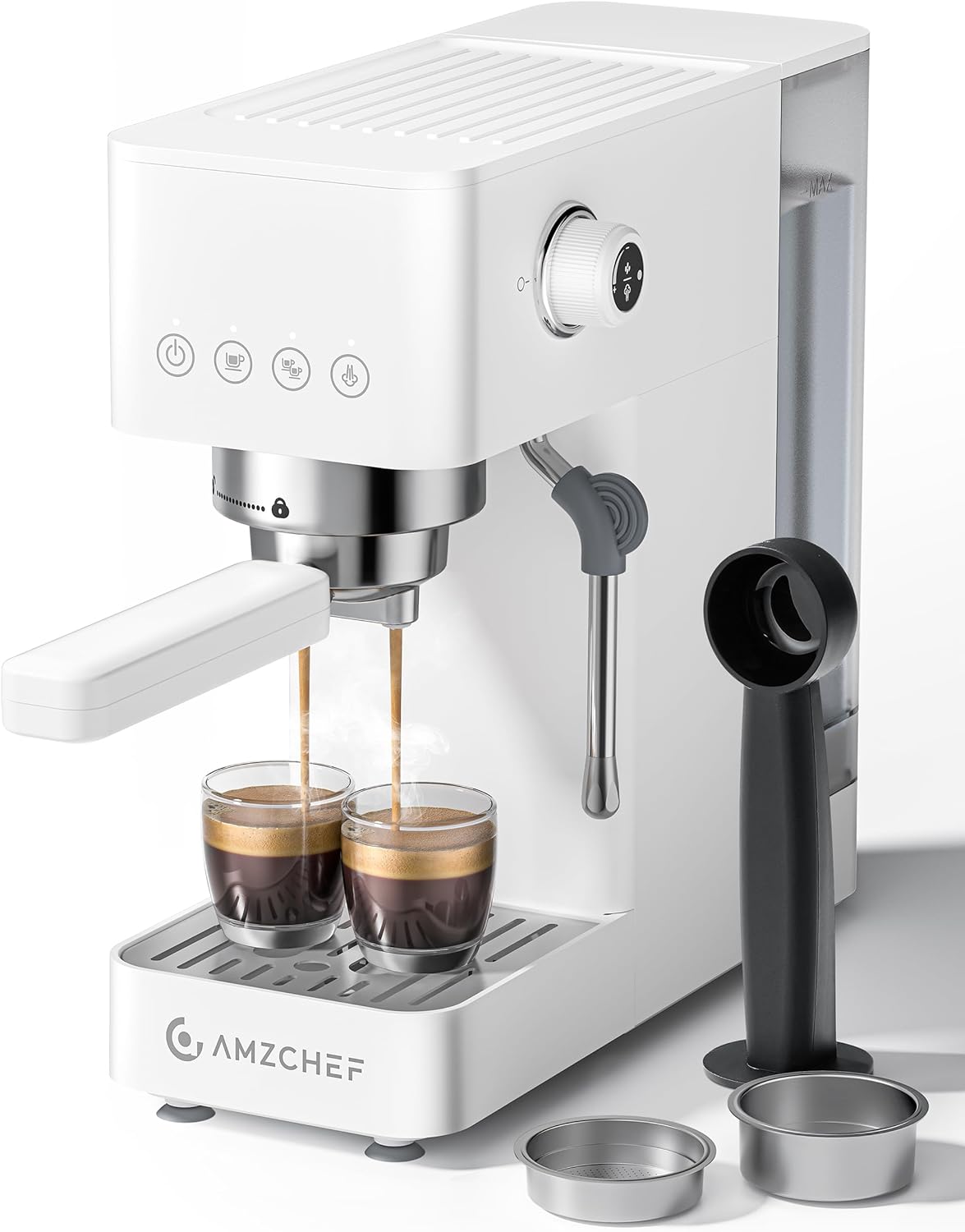
5. Best for a large water tank: AMZCHEF Compact 20 Bar Espresso Machine
The AMZCHEF Compact Espresso Machine has a 20 bar pump pressure and a 1350W heating system with listed PID temperature control. It measures 12.5″D x 7″W x 14.4″H and weighs 8.2 pounds. A key feature is its large, removable 50 oz (approximately 1.5-liter) water tank.
This semi-automatic machine offers one-touch operation with buttons for single or double shots and a customizable extraction time. It includes a 360° rotating steam wand for milk frothing. The machine is designed for use with ground coffee and a reusable filter.
Best for: Households or offices that want to minimize water tank refills with a machine that has programmable shot options.
Pros
- Large, removable 50 oz water tank.
- Higher listed pump pressure (20 bar).
- Includes programmable shot buttons and PID temperature control.
- Steam wand rotates 360° for flexibility.
Cons
- Tallest and heaviest model in this comparison.
- Higher wattage (1350W); ensure your outlet can handle it.
- The listing does not mention a cup warmer.
Compact espresso machines at a glance
| Model | Dimensions (DxWxH) | Weight | Listed Pressure | Water Tank Capacity |
|---|---|---|---|---|
| HBN Espresso Machine | 12.91″ x 7.28″ x 13.58″ | 4.1 lbs | 3.5 bar | 240 ml (carafe) |
| XIXUBX Compact | 8.3″ x 6″ x 11.8″ | 3.3 lbs | 3.5 bar | 240 ml (cup) |
| IMUSA 4 Cup | 7.48″ x 9.05″ x 11.02″ | 4.8 lbs | Not listed | 4 cups |
| Aercana 20 Bar | 12.2″ x 5.32″ x 11.5″ | Not listed | 20 bar | 1 liter |
| AMZCHEF Compact | 12.5″ x 7″ x 14.4″ | 8.2 lbs | 20 bar | 50 oz |
How to choose a compact espresso machine
When shopping for a best compact espresso machine, the first thing to check is the physical dimensions. Measure the space on your counter where the machine will live, paying attention to both the width and depth. Measure the space under your cabinets and compare it with the listed dimensions. Also, consider the weight if you plan to move or store the machine frequently.
Next, look at how the machine operates. Semi-automatic machines, like all the models here, require you to start and stop the brew and steam functions manually. This offers more control than a fully automatic machine but is simpler than a fully manual lever machine. Check if the machine uses a pump to create pressure (often listed as 9, 15, or 20 bar) or uses a different system like steam pressure (often listed as 3-4 bar). For more on these features, see our guide on espresso machine features explained.
What to look for
- Dimensions: Verify the depth, width, and height will fit your available space.
- Capacity: Decide if a small carafe or a larger removable water tank better suits your daily use.
- Pressure System: Determine if you prefer a higher-pressure pump system or a simpler steam-pressure machine.
- Milk Frother: Ensure a steam wand or frother is included if you drink milk-based drinks like lattes and cappuccinos.
Finally, consider the listed features that affect convenience and cleanup. A removable water tank and drip tray make refilling and cleaning easier. A cup warmer can help keep your espresso hot, but not all compact models include one. For a deeper dive into space-saving options, read our guide to compact espresso machines.
FAQ
What’s the difference between 3.5 bar and 20 bar pressure?
Machines listing around 3-4 bar typically use steam pressure to force water through the coffee grounds. Machines listing 9, 15, or 20 bar use an electric pump to generate higher pressure. Pump machines are generally associated with creating a richer crema and more intense flavor, but the grind quality, coffee freshness, and technique are also critical. You can learn more about how pressure affects extraction in our article on espresso machine features.
Can I use pre-ground coffee in these machines?
Yes, all the machines in this comparison are listed for use with ground coffee. Some include a specific filter basket size (like #4). For the best results, use coffee ground specifically for espresso, as the grind size significantly impacts extraction and flavor.
Are compact espresso machines difficult to clean?
Cleaning ease often depends on the design. Look for features like a removable drip tray, a detachable water tank, and a washable filter basket. Machines with a steam wand will require you to purge and wipe the wand after each use to prevent milk from drying inside. Always follow the cleaning instructions in the manufacturer’s manual.
Do these machines work for making regular coffee?
Espresso machines are designed to brew a concentrated shot of coffee under pressure. You can dilute an espresso shot with hot water to make an Americano, which is similar in strength to regular drip coffee but with a different flavor profile. These machines are not designed to brew a full pot of filter coffee.
References
- Amazon product listings and manufacturer specifications (accessed October 2026)
- Compact Espresso Machines category
- Espresso Machine Features Explained: Boilers, PID, Grinders and Steam Wands
- A Guide to Compact and Space-Saving Espresso Machines