Quick answer
Our overall pick for the best espresso grinder is the AMZCHEF Burr Coffee Grinder for its wide grind range, large capacity, and included portafilter compatibility. The SHARDOR grinder suits those who prioritize precise timing and a dedicated portafilter holder, while the Fellow Opus 2 is a strong choice for those wanting stepless adjustment for ultimate dial-in control.
Choosing the best espresso grinder is a key step in making great coffee at home. A good grinder creates uniform grounds, which is essential for balanced extraction and flavor. This guide compares several electric burr grinders based on their listed specifications and features to help you find the right one for your kitchen.
Our picks at a glance

Pros
- Wide range of 48 grind settings
- Large 10.6-ounce bean hopper
- Includes portafilter compatibility (51-54mm/58mm)
- Touchscreen with cup and timer controls
Cons
- The listing does not mention if it has stepless adjustment for finer tuning
- Hopper and grounds chamber require manual cleaning

Pros
- Very precise 0.1-second timer adjustment
- Includes a dedicated portafilter cradle
- 51 precise grind settings
- Comes with a dosing ring and residual cleaner
Cons
- Smaller listed grounds chamber capacity (1.4 oz)
- The listing does not specify the bean hopper capacity

Pros
- Large 8-ounce bean hopper and high-capacity grind chamber
- Flat burr design for uniform grinding
- 4–18 cup quantity selector
- Includes an 18-month warranty
Cons
- Fewer grind settings (18) than other models
- The listing does not mention portafilter compatibility or a dedicated holder
- Not specifically designed for espresso-first workflow

Pros
- Smart memory function recalls last setting
- 0.1-second precise timer
- Includes a portafilter holder (51mm & 58mm)
- Large 11.3-ounce bean hopper
Cons
- Powered by an AC adapter (not a standard plug)
- The listing does not specify the motor wattage
Pros
- Simple one-touch operation with memory
- 15 settings with micro-adjustments (43 total)
- Large 12-ounce UV-blocking hopper
- Two-year warranty
Cons
- The listing does not mention portafilter compatibility or a timer
- Lower listed wattage (100W) than some models

Pros
- Stepless adjustment for precise dialing-in
- Designed for near-zero grind retention
- Includes magnetic catch cups for portafilters
- 48mm conical burrs
Cons
- The listing does not specify a timer or cup quantification feature
- The listing does not mention the bean hopper capacity or motor wattage
How we chose
Our editors compared the manufacturer listings and specifications for these grinders on Amazon as of October 2026. We did not perform hands-on testing. Our picks are based on evaluating the listed features, such as grind settings, burr type, capacity, and workflow aids like timers or portafilter holders, to identify which models offer the most suitable combination for espresso brewing at home.
What to look for
- Grind Settings: Espresso requires a fine, precise grind. Look for a wide range of settings or stepless adjustment.
- Burr Type: Conical or flat burrs create more uniform grounds than blade grinders.
- Workflow Features: Portafilter holders, precise timers, and anti-static designs make the process cleaner and more repeatable.
- Capacity: Consider how much coffee you brew at once and how often you want to refill the bean hopper.
Best Grinders for Espresso: our picks in detail
1. Best overall espresso grinder: AMZCHEF Burr Coffee Grinder
The AMZCHEF grinder is our overall pick for the best espresso grinder. It features 48 grind settings, ranging from fine for espresso to coarse for French press. It uses 40mm stainless steel conical burrs for uniform grinding and includes a touchscreen for setting the grind time or selecting 2 to 12 cups.
Its design includes anti-static technology to reduce mess and a large, 10.6-ounce hopper with UV protection. The listing notes it fits 51-54mm and 58mm portafilters and comes with a cleaning brush. With a 150-watt motor, it’s intended for home barista use with espresso, drip, pour over, and cold brew.
Best for: Home baristas who want a versatile grinder with a large capacity and wide range of settings for espresso and other brew methods.
Pros
- Wide range of 48 grind settings
- Large 10.6-ounce bean hopper
- Includes portafilter compatibility (51-54mm/58mm)
- Touchscreen with cup and timer controls
Cons
- The listing does not mention if it has stepless adjustment for finer tuning
- Hopper and grounds chamber require manual cleaning
2. Best for precise timing and portafilter workflow: SHARDOR Conical Burr Espresso Grinder
The SHARDOR grinder emphasizes precise control for espresso. It offers 51 precise grind settings and features a precision electronic timer adjustable in 0.1-second increments up to 60 seconds. It includes a dedicated portafilter cradle, allowing you to grind directly into a portafilter.
It uses 40mm stainless steel conical burrs and has anti-static technology. The listed capacity for the grounds chamber is 1.4 ounces. It comes with a dosing ring, a grounds residual cleaner, and a cleaning brush. With a 165-watt motor, it’s recommended for use with espresso machines, drip coffee, and French press.
Best for: Espresso enthusiasts who value a highly precise timer and the convenience of grinding directly into a portafilter.
Pros
- Very precise 0.1-second timer adjustment
- Includes a dedicated portafilter cradle
- 51 precise grind settings
- Comes with a dosing ring and residual cleaner
Cons
- Smaller listed grounds chamber capacity (1.4 oz)
- The listing does not specify the bean hopper capacity
3. Best for high-volume drip and occasional espresso: Cuisinart Supreme Grind DBM-8P1
The Cuisinart Supreme Grind is a flat burr grinder with an 8-ounce bean hopper and a grind chamber that can hold grounds for up to 32 cups. It offers 18 grind levels, from ultra-fine for espresso to extra-coarse for French press.
It includes an adjustable slide dial to select grounds for 4 to 18 cups and has an automatic shutoff. The grinder has a 500-watt motor and a safety interlock. It comes with a cleaning brush and scoop and has an 18-month limited warranty.
Best for: Households that brew large batches of drip coffee but also want the option to grind for occasional espresso.
Pros
- Large 8-ounce bean hopper and high-capacity grind chamber
- Flat burr design for uniform grinding
- 4–18 cup quantity selector
- Includes an 18-month warranty
Cons
- Fewer grind settings (18) than other models
- The listing does not mention portafilter compatibility or a dedicated holder
- Not specifically designed for espresso-first workflow
4. Best for repeatable dosing with smart memory: Cusinice Conical Burr Coffee Grinder
The Cusinice grinder features a 0.1-second electronic timer with a smart memory function that recalls your last setting. It has 34 grind settings and uses 40mm stainless steel conical burrs.
It includes an anti-static design, a touchscreen for cup and time control, and a portafilter holder compatible with 51mm and 58mm portafilters. The bean hopper holds 11.3 ounces. It is powered by an AC adapter.
Best for: Anyone who wants a grinder that remembers their last setting for a fast, consistent morning routine.
Pros
- Smart memory function recalls last setting
- 0.1-second precise timer
- Includes a portafilter holder (51mm & 58mm)
- Large 11.3-ounce bean hopper
Cons
- Powered by an AC adapter (not a standard plug)
- The listing does not specify the motor wattage
5. Best for simple, one-touch operation: OXO Brew Conical Burr Grinder
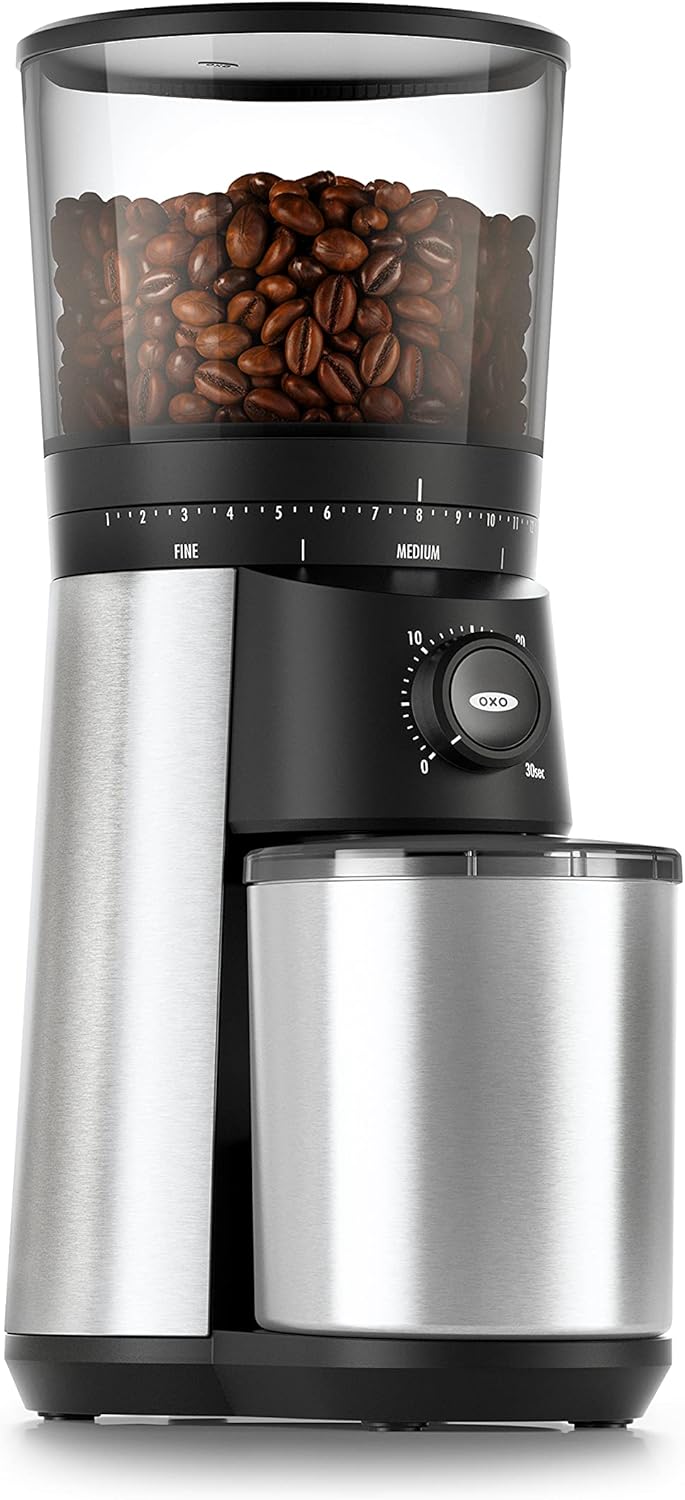
The OXO Brew grinder is designed for simplicity with a one-touch start that remembers your last setting. It has 15 primary grind settings with 43 micro-adjustments, offering a wide range from fine to coarse.
It uses 40mm stainless steel conical burrs and has a large, removable 12-ounce hopper with a UV-blocking tint. It features a 100-watt motor and comes with a two-year warranty.
Best for: Coffee drinkers who want a straightforward, no-fuss grinder with a simple one-button operation.
Pros
- Simple one-touch operation with memory
- 15 settings with micro-adjustments (43 total)
- Large 12-ounce UV-blocking hopper
- Two-year warranty
Cons
- The listing does not mention portafilter compatibility or a timer
- Lower listed wattage (100W) than some models
6. Best for stepless grind adjustment: Fellow Opus 2 Conical Burr Grinder
The Fellow Opus 2 features stepless grind adjustment, allowing for continuous, tiny changes to the grind size, which is ideal for dialing in espresso. It uses 48mm conical burrs and is designed for near-zero grind retention.
It includes anti-static technology and comes with two magnetic catch cups, one of which is compatible with 54mm and 58mm portafilters. It has an auto-stop function and is built for a range of brew methods from espresso to cold brew.
Best for: Coffee enthusiasts who experiment with different brew methods and want the finest possible control over their grind size for espresso.
Pros
- Stepless adjustment for precise dialing-in
- Designed for near-zero grind retention
- Includes magnetic catch cups for portafilters
- 48mm conical burrs
Cons
- The listing does not specify a timer or cup quantification feature
- The listing does not mention the bean hopper capacity or motor wattage
Espresso grinders at a glance
| Grinder | Grind Settings | Burr Type & Size | Key Feature | Bean Hopper Capacity |
|---|---|---|---|---|
| AMZCHEF | 48 settings | 40mm conical | Fits 51-54/58mm portafilter | 10.6 oz |
| SHARDOR | 51 settings | 40mm conical | 0.1s timer & portafilter cradle | Not listed |
| Cuisinart | 18 settings | Flat burr | 4–18 cup selector | 8 oz |
| Cusinice | 34 settings | 40mm conical | Smart memory function | 11.3 oz |
| OXO Brew | 15 + micro | 40mm conical | One-touch start with memory | 12 oz |
| Fellow Opus 2 | Stepless | 48mm conical | Stepless adjustment | Not listed |
How to choose the best espresso grinder
Selecting the best espresso grinder depends on how you brew and the features that matter most to your routine. The core job of any grinder is to produce uniform coffee grounds, which is non-negotiable for espresso’s fine grind requirement. Uneven grounds lead to uneven extraction, resulting in a cup that can be both sour and bitter.
First, consider the adjustment mechanism. Stepped grinders, like most models here, offer fixed settings. More steps generally mean more precision. The Fellow Opus 2 offers stepless adjustment, which allows for infinite fine-tuning—a major advantage for dialing in espresso but potentially less straightforward for beginners. Next, look at burrs. Conical burrs are common in home grinders and provide a good balance of performance and quiet operation. Flat burrs, like in the Cuisinart, can also produce excellent uniformity.
Finally, evaluate workflow. Features like a portafilter holder (AMZCHEF, SHARDOR, Cusinice) let you grind directly into your espresso machine’s basket, reducing mess. Precise timers (SHARDOR, Cusinice) or cup quantifiers (AMZCHEF) help achieve consistent doses, which is critical for espresso. Anti-static technology, mentioned by several models, helps keep grounds from clinging and making a mess. For a deeper dive into these factors, see our general guide on how to choose a coffee grinder.
FAQ
Why can’t I use a blade grinder for espresso?
Blade grinders chop beans unevenly, creating a mix of fine powder and large chunks. Espresso requires a very fine, uniform grind so water passes through the coffee puck at the correct rate and extracts flavor evenly. An inconsistent grind from a blade grinder will lead to poor, unbalanced extraction.
What’s the difference between stepped and stepless grind adjustment?
Stepped grinders have fixed, click-stop settings (like 34 or 48 settings). Stepless grinders have a continuous adjustment ring with no stops, allowing for tiny, incremental changes. Stepless adjustment is often preferred for espresso because it allows for extremely precise dialing-in to get the perfect extraction time and flavor.
Is a higher wattage motor better in a coffee grinder?
A motor’s wattage indicates its power consumption, not necessarily grinding quality or speed. A well-designed burr set is more important for grind uniformity. However, a very low-wattage motor might struggle or slow down with dense beans. Follow the manufacturer’s guidance for use.
What does “grind retention” mean?
Grind retention refers to the amount of ground coffee that gets left inside the grinder after grinding, instead of making it into your portafilter or catch cup. This retained coffee can stale and then mix into your next fresh grind, affecting flavor. Some grinders, like the Fellow Opus 2, are designed to minimize this.
References
- Amazon product listings and manufacturer specifications (accessed October 2026)
- Espresso Grinders Buying Guide, The Coffee Maker Store
- What Makes a Grinder Suitable for Espresso?, The Coffee Maker Store