By Owen Palmer
Quick answer
Our overall pick for the best espresso machine for home is the CASABREWS CM5418, a compact semi-automatic with a pressure gauge and steam wand. The Breville Barista Express suits those wanting a built-in grinder, while the AMZCHEF and CHULUX models offer advanced temperature control and a very slim design, respectively.
Choosing the best espresso machine for home can feel overwhelming with so many models promising cafe-quality results. The key is understanding which features matter most for your daily routine and space. We’ve compared manufacturer listings and specifications to highlight machines that excel in different areas, from compact kitchens to hands-on brewing.
Our picks are based on a detailed analysis of listed features, capacities, and operation modes. We looked for machines that provide the essential tools for making espresso and milk-based drinks at home, helping you find the best espresso machine for your countertop.
Our picks at a glance
Pros
- Includes a pressure gauge for monitoring extraction.
- Compact, space-saving design suitable for smaller kitchens.
- Semi-automatic operation with a steam wand for milk drinks.
Cons
- The listing does not mention a built-in grinder; it uses ground coffee.
- Requires a cooldown period between steaming milk and brewing coffee, as noted in the tips.
- The listed capacity of 2.1 pounds is ambiguous for water or coffee.

Pros
- Integrated conical burr grinder with dose control
- Features PID for precise temperature control
- Includes low-pressure pre-infusion
- Comes with several useful accessories (tamper, scoop)
Cons
- Manual operation requires more user skill
- The listing does not mention a removable water tank

Pros
- Wide temperature adjustment range (190°F–201°F)
- 44 adjustable grind settings for different brew methods
- Includes a cold brew mode and descaling function
- Semi-automatic operation with a touch screen
Cons
- The listed 6-ounce capacity is on the smaller side
- The listing does not mention a pressure gauge for extraction

Pros
- Extremely slim profile (5.5" wide) saves counter space.
- Includes a pressure gauge and pre-infusion function.
- Has a large 40-ounce water tank and auto shut-off.
Cons
- The listing does not mention a built-in grinder; it uses ground coffee.
- Semi-automatic operation requires manual grinding and tamping.
- The listing's special features include 'PID Temperature Control' but provides no details on adjustability.
How we chose
Our selections come from comparing manufacturer listings and specifications on Amazon as of October 2026. We did not perform hands-on testing. We evaluated machines based on their listed features, including pump pressure, operation mode (manual, semi-automatic), included components like grinders or steam wands, and physical dimensions.
We prioritized machines that clearly listed features important for home espresso, such as temperature control, pre-infusion, and capacity. Our goal was to identify which models offer the right combination of tools for different types of home baristas.
Best Espresso Machines for Home: our picks in detail
1. Best overall: CASABREWS CM5418 Compact Espresso Machine
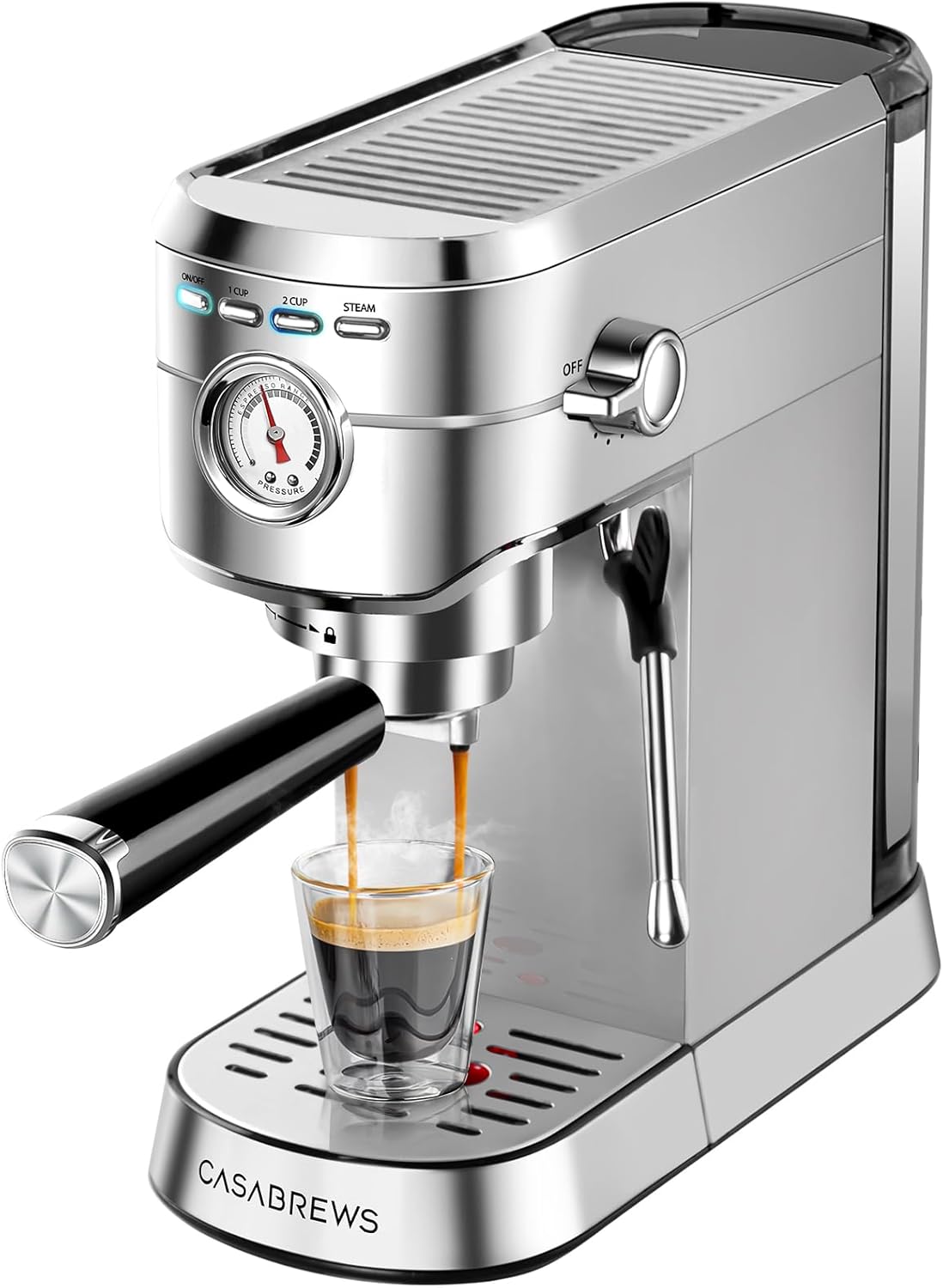
The CASABREWS CM5418 is a semi-automatic espresso machine with a 20-bar pump and a built-in pressure gauge, which the listing says helps you make adjustments during extraction. It includes a steam wand for frothing milk and has a 34-ounce detachable water tank. The machine has a brushed stainless steel finish and measures 12.28″D x 5.47″W x 11.97″H.
According to the listing, the 1350-watt boiler allows for quick preparation of espresso-based drinks like lattes and cappuccinos. The manufacturer provides specific tips for operation, such as allowing the machine to cool between brewing and steaming to avoid overheating protection mode.
Best for: Home baristas who want a compact machine with visual pressure feedback for dialing in shots.
Pros
- Includes a pressure gauge for monitoring extraction.
- Compact, space-saving design suitable for smaller kitchens.
- Semi-automatic operation with a steam wand for milk drinks.
Cons
- The listing does not mention a built-in grinder; it uses ground coffee.
- Requires a cooldown period between steaming milk and brewing coffee, as noted in the tips.
- The listed capacity of 2.1 pounds is ambiguous for water or coffee.
2. Best with built-in grinder: Breville Barista Express Espresso Machine
The Breville Barista Express is a manual espresso machine with an integrated precision conical burr grinder that doses directly into the portafilter. It features digital temperature control (PID) and a low-pressure pre-infusion function, which the listing says helps draw out flavors evenly. The machine includes a powerful steam wand for creating microfoam.
Constructed with stainless steel, it has a grind size dial and comes with accessories like a coffee scoop, filter, integrated tamper, and a razor dose trimming tool. The listed capacity is 1 cup, and its dimensions are 13.8″D x 12.5″W x 15.9″H.
Best for: Drinkers who want an all-in-one bean-to-cup experience with manual control.
Pros
- Includes an integrated conical burr grinder for fresh grinding.
- Features digital temperature control (PID) and pre-infusion.
- Comes with several useful accessories like a tamper and dose trimming tool.
Cons
- Manual operation requires more hands-on steps.
- Larger footprint may not suit very small counters.
- The listed 1-cup capacity is small for making multiple drinks quickly.
3. Best for precise temperature control: AMZCHEF Espresso Machine With Grinder
The AMZCHEF espresso machine includes a built-in grinder with 44 adjustable settings, suitable for espresso to French press. It offers precision temperature control adjustable from 190°F to 201°F. The machine has a smart touch screen, one-touch brewing, and a dedicated cold brew mode.
It features an 8mm stainless steel steam wand and a 1350-watt heating system. The water tank holds 60 ounces, and the machine has a descaling function. It is made of stainless steel and measures 12.5″D x 10.82″W x 13.38″H.
Best for: Enthusiasts who want granular control over grind size and brew temperature.
Pros
- Offers adjustable brew temperature control (190°F–201°F).
- Built-in grinder with 44 settings for multiple brew methods.
- Includes a cold brew mode and a large 60-ounce water tank.
Cons
- The listing does not mention a pressure gauge for extraction feedback.
- Semi-automatic operation may have a learning curve.
- At 13.9 pounds, it is a moderately heavy unit.
4. Best for narrow spaces: CHULUX Slim Espresso Machine
The CHULUX Slim Espresso Machine is a semi-automatic model with a 20-bar pump and a very compact design, measuring just 5.5 inches in width. It features a pressure gauge, pre-infusion function, and a 40-ounce water tank. The 1350-watt boiler heats in about 30 seconds, according to the listing.
It includes a steam wand for making milk foam and has an auto shut-off feature after 25 minutes of inactivity. The listing notes the boiler, water tank, brew head, and steam wand are made of food-safe materials.
Best for: Anyone with very limited counter space who still wants a pressure gauge and steam wand.
Pros
- Extremely slim profile (5.5″ wide) saves counter space.
- Includes a pressure gauge and pre-infusion function.
- Has a large 40-ounce water tank and auto shut-off.
Cons
- The listing does not mention a built-in grinder; it uses ground coffee.
- Semi-automatic operation requires manual grinding and tamping.
- The listing’s special features include ‘PID Temperature Control’ but provides no details on adjustability.
Our picks at a glance
| Machine | Operation | Built-in Grinder | Key Listed Feature | Width |
|---|---|---|---|---|
| CASABREWS CM5418 | Semi-Automatic | No | Pressure Gauge | 5.47″ |
| Breville Barista Express | Manual | Yes | Integrated Grinder & PID | 12.5″ |
| AMZCHEF with Grinder | Semi-Automatic | Yes (44 settings) | Temp Control (190°F–201°F) | 10.82″ |
| CHULUX Slim | Semi-Automatic | No | 5.5″ Width, Pressure Gauge | 5.5″ |
How to choose the best espresso machine for home
Your ideal home espresso machine depends on your available space, how involved you want to be in the process, and the types of drinks you enjoy. The first decision is often between manual, semi-automatic, and super-automatic machines. Manual and semi-automatic models, like our picks, give you more control over the shot but require you to grind, dose, and tamp the coffee yourself. For a deeper dive into the options, see our guide to choosing your first espresso machine.
Consider your kitchen’s layout. A machine’s footprint isn’t just about length and depth; height is crucial if it sits under cabinets, and width determines how much other gear can fit beside it. The CHULUX model shows how a machine under 6 inches wide can still offer professional features. Also, check the water tank capacity—a larger tank means less frequent refills but also adds to the machine’s overall size.
What to look for
- Operation Mode: Manual machines offer the most control, while semi-automatic handle water flow for you. Decide how hands-on you want to be.
- Grinder Inclusion: A built-in grinder is convenient and ensures fresh grounds, but it increases the machine’s size, cost, and complexity.
- Milk Frothing: If you drink lattes or cappuccinos, a steam wand is essential. Look for one that swivels easily.
- Useful Features: Pressure gauges, temperature controls, and pre-infusion can help you improve your shots but add to the learning curve.
Finally, think about the workflow. Making espresso involves several steps: grinding, tamping, brewing, and steaming milk. Machines with a single boiler, like most home models, often require a pause between brewing and steaming to let the temperature adjust. Always follow the manufacturer’s manual for heating, cooling, and maintenance procedures to ensure safety and longevity. For more on how home machines differ from what you see in cafes, read Home vs. Commercial Espresso Machines: Key Differences.
FAQ
What’s the difference between semi-automatic and manual espresso machines?
A semi-automatic machine typically starts and stops the water pump with the push of a button, giving you control over shot volume but automating the pump. A manual machine, like the Breville Barista Express, often requires you to activate and control the pump yourself, usually with a lever or dial, offering more direct influence over the pressure profile during extraction.
Do I need a machine with a built-in grinder?
Not necessarily, but it is a major convenience. Freshly ground coffee is critical for good espresso. A built-in grinder saves counter space and ensures your beans are ground just before brewing. If you choose a machine without one, you’ll need to buy a separate quality grinder designed for espresso’s fine consistency.
Is a 20-bar pump better than a 15-bar pump?
The listed bar pressure refers to the pump’s maximum potential pressure, not what’s used during extraction. Proper espresso extraction typically happens at lower pressures. A capable pump should provide stable pressure. The presence of features like pre-infusion or a pressure gauge is often more informative than the maximum bar number alone.
How important is a pressure gauge?
A pressure gauge provides real-time feedback during extraction, which can be a valuable learning tool. It helps you see if your grind size, dose, and tamp are creating the right resistance. It’s not essential for making coffee, but it’s very useful for diagnosing issues and consistently pulling good shots once you learn to interpret it.
References
- Amazon product listings and manufacturer specifications (accessed October 2026)
- Specialty Coffee Association
About Owen Palmer
Owen Palmer is part of our editorial team and reviews and edits our coffee machines guides, checking product details against manufacturer specifications and owner feedback.